
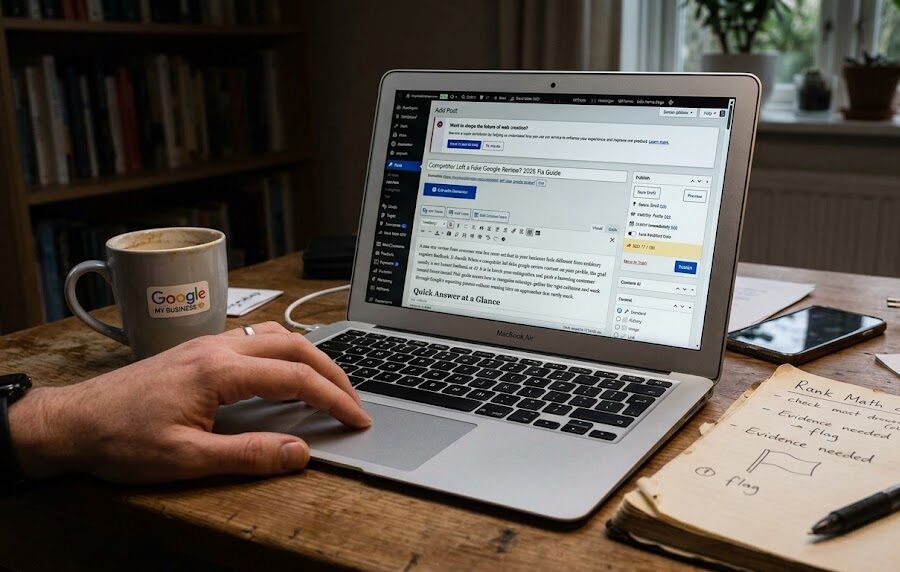
A one star review from someone who has never set foot in your business feels different from ordinary negative feedback. It should. When a competitor left fake google review content on your profile, the goal usually is not honest feedback at all. It is to knock your rating down and push a browsing customer toward them instead. This guide covers how to recognise sabotage, gather the right evidence and work through Google’s reporting process without wasting time on approaches that rarely work.
Quick Answer at a Glance
Here is the short version before the detail.
| Question | Short Answer |
|---|---|
| Can a fake competitor review be removed | Yes, if it breaks Google’s policy on fake engagement or conflict of interest. |
| First step | Screenshot the review immediately, before it can be edited or deleted. |
| Where to report it | Flag it directly on the listing and through Google’s official review reporting form. |
| How long removal usually takes | A few days for clear cases, two to four weeks for borderline ones. |
| Should you respond publicly first | Yes, a calm factual response while the report is pending. |
Signs a Negative Review Is Competitor Sabotage Rather Than a Real Complaint
Not every harsh review is sabotage. Genuine customers do leave one star reviews over real problems. A few patterns point toward something else going on.
A reviewer with no order history, no booking record and no way to have used your business is the clearest sign. Reviews posted from a profile that has also left one star reviews for several other businesses in your exact niche, sometimes on the same day, point toward a pattern rather than a one off complaint. Vague language that never names a specific product, member of staff or date also stands out, since real complaints almost always include some concrete detail.
Timing matters too. A cluster of negative reviews appearing right after a product launch, a price change or a piece of local press coverage about your business is worth a closer look, especially if a rival business gained something from the timing.
Why Sabotage Reviews Often Cluster Around Specific Events
Competitor sabotage rarely happens in isolation. It tends to cluster around moments when a business gains visible ground, a new location opening, a strong piece of local press coverage or a noticeable jump in bookings after a marketing push.
This pattern gives business owners a useful diagnostic. If a negative review lands within days of a clear win for the business, that timing alone is worth noting in the evidence file. Paired with an unfamiliar reviewer name and vague wording, it adds real weight to a report that Google’s investigators take seriously.
Step One: Lock Down the Evidence Before It Disappears
Screenshot the review the moment you spot it, including the reviewer’s profile page, their review history and the exact wording. A review can be edited or deleted at any point. A screenshot taken today may be the only record of what it originally said.
Note the date and time, the reviewer’s display name and, where visible, any other reviews on their profile. If the reviewer has left similar negative reviews for other local businesses, screenshot those too. This pattern evidence often matters more to a reviewer of your case than the single review itself.
Export any conversation history tied to the reviewer’s name if your business uses a CRM or booking platform with search functionality. A quick search takes less than five minutes and either confirms a real customer relationship or strengthens the case that none exists.
Step Two: Check Whether the Reviewer Has Any Real Connection to Your Business
Search your booking system, point of sale records and customer database for the reviewer’s name. A genuine one star review usually traces back to an actual transaction or visit, even an unhappy one. No match at all strengthens the case that the review breaks Google’s policy on reviews from people with no real connection to the business.
Check your team too. Occasionally a review turns out to trace back to a former employee or someone connected to a competing business, which falls under a conflict of interest violation rather than an honest customer complaint.
Step Three: Report It Through the Right Channels
Flag the review directly from your Google Business Profile using the three dot menu next to it. Separately, submit a report through Google’s official review reporting form, since flagging from the profile alone does not always trigger a full review.
For a full breakdown of the reporting process itself, including screenshots of each step, this guide on Google reviews compared to other platforms also covers how review policies differ once a dispute needs to be escalated between platforms.
Include your evidence in the report where the form allows it. A report that simply says the review is fake, with no supporting detail, is far less likely to move quickly than one that names the specific policy violation and attaches proof.
How Google’s Review Team Actually Investigates a Report
Google does not publish its exact internal process. The general pattern is consistent across most cases businesses report though. An automated system does an initial pass, catching obvious spam and duplicate content quickly. Anything that does not get caught automatically moves to human review, which is where evidence and a clear policy citation matter most.
Clear cut violations, such as an account with zero connection to the business or an identical review copied across several unrelated listings, tend to resolve within a few business days. Borderline cases, where the review is harsh but not obviously fake, can take two to three weeks and sometimes need a second report or an appeal before anything changes.
Multiple reports on the same review from different staff members or business partners do not necessarily speed things up. Submitting several nearly identical flags the same day can occasionally look like coordinated flagging abuse instead. One well documented report from the business owner, followed by a single follow up if there is no response within two weeks, tends to work better.
What to Do While the Report Is Pending
Respond to the review publicly with a short, professional reply. Do not accuse the reviewer of being a competitor in the public response, even if you are confident that is the case. State plainly that you have no record of this customer and that you have reported the review for investigation.
Keep serving customers and collecting genuine reviews in the background. A single suspicious review carries far less visible weight on a profile that keeps adding real positive reviews around it, regardless of how long the removal takes.
When Reporting Fails: What Happens If Google Will Not Remove It
Sometimes a review that looks obviously fake to you does not clearly break Google’s written policy. The report gets rejected anyway. This is more common than most business owners expect.
At that point the realistic options narrow. A second, more detailed report with fresh evidence sometimes succeeds where the first did not. For a persistent pattern from an identifiable source, a formal legal letter through a solicitor is an option, though this tends to be reserved for serious, ongoing harassment rather than a single review. For most cases, shifting focus to building a stronger genuine review base around the fake one is the more practical path forward.
A structured audit of the whole profile, similar to a professional review of eligible flagged content, can catch other policy violating reviews sitting on the profile at the same time, not just the one that first drew attention.
Building a Paper Trail: What UK Small Claims Actually Requires
Business owners sometimes ask whether a fake review from an identifiable competitor can lead to a small claims case for defamation or malicious falsehood. It can, in theory. The bar sits higher than most expect though.
A viable claim generally needs the reviewer’s real identity confirmed, not just suspected, clear evidence the statements are false rather than simply unflattering and some demonstrable business impact, such as lost bookings tied to the timing of the review. Screenshots alone rarely meet that bar. IP address logs, admission from the reviewer or a documented pattern across multiple platforms strengthen a case considerably. Most UK solicitors specialising in this area will offer an initial consultation to assess whether a specific case is worth pursuing before any costs are committed.
Checklist: Handling a Fake Competitor Review
- Screenshot the review, the reviewer’s profile and their other reviews immediately.
- Search your own records for any trace of a real transaction from that reviewer.
- Flag the review directly from your Google Business Profile.
- Submit a separate detailed report through Google’s official reporting form with evidence attached.
- Post a calm, factual public response while the report is pending.
- Keep collecting genuine reviews so the fake one carries less visible weight.
- If the first report is rejected, resubmit with additional evidence rather than giving up after one attempt.
How Buy Social Review Fits Into This
Buy Social Review Team: The team has handled cases where a suspicious review traced back to a rival business, building the evidence file and filing the formal report so the business owner does not have to learn Google’s reporting system from scratch under pressure.
Businesses dealing with a suspected fake review can get a free audit of eligible reviews on their profile to see what qualifies for removal. It is also worth comparing package options for ongoing profile protection if sabotage attempts turn out to be a repeated problem rather than a one off.
FAQs About competitor left fake google review
How can I find out who really posted a fake review?
Google does not reveal reviewer identities to businesses directly. Sometimes the reviewer’s public profile, their other reviews or their display name gives enough of a clue. In serious cases a solicitor can request identity disclosure from Google through the proper legal channels.
Can I be sued for accusing a competitor of leaving a fake review?
Making a public accusation without solid proof carries real risk. Keep any public comments limited to facts about your own records, such as having no booking under that name. Save direct accusations for the private report to Google or a solicitor.
Does reporting a review hurt my relationship with Google if the report is wrong?
No. Google expects businesses to report reviews they believe violate policy. An honest, mistaken report does not carry any penalty. Reports that are clearly abusive or made in bad faith repeatedly are the only pattern likely to draw scrutiny.
What if the fake review comes from a competitor’s employee rather than the owner?
The same reporting process applies. A review from an employee of a competing business still falls under a conflict of interest violation, regardless of whether the business owner personally wrote it or asked someone else to.
Should I contact the competitor directly about the review?
Generally no. A direct confrontation rarely resolves anything and can escalate the situation. Channel the response through Google’s official reporting process and, if it continues, a solicitor rather than a direct approach to the other business.
Can multiple fake reviews from the same source get an account banned?
Google can suspend or restrict a reviewer account that repeatedly posts policy violating content once a clear pattern is identified. A well documented pattern across several businesses strengthens each individual report considerably. Business owners who discover a reviewer has targeted several unrelated companies sometimes coordinate reports with those other businesses, which gives Google’s investigators a clearer picture of the pattern in one sitting.
Does a fake review affect my Google Ads performance too?
Indirectly, yes. A lower star rating can reduce click through rates on both organic listings and paid ads, since shoppers scan the rating before clicking either. Removing a fake review that dragged the rating down tends to help both channels.
How do I tell my genuine customers apart from a fake review during an audit?
Cross reference the reviewer’s name and review date against your booking system, till records or CRM. A genuine customer almost always leaves some kind of trace in your own records, even if the review itself is negative.
Final Thoughts
Discovering that a competitor left fake google review content on your listing is frustrating. The response that actually works is methodical rather than emotional. Screenshot everything first, check your own records, then report through the proper channels with evidence attached. Most clear cut sabotage cases do get resolved once Google has the right documentation in front of them.
Follow Us for More Google Review Tips
If you want more Google Review strategies Local SEO tips and online reputation insights follow our official social media profiles.