
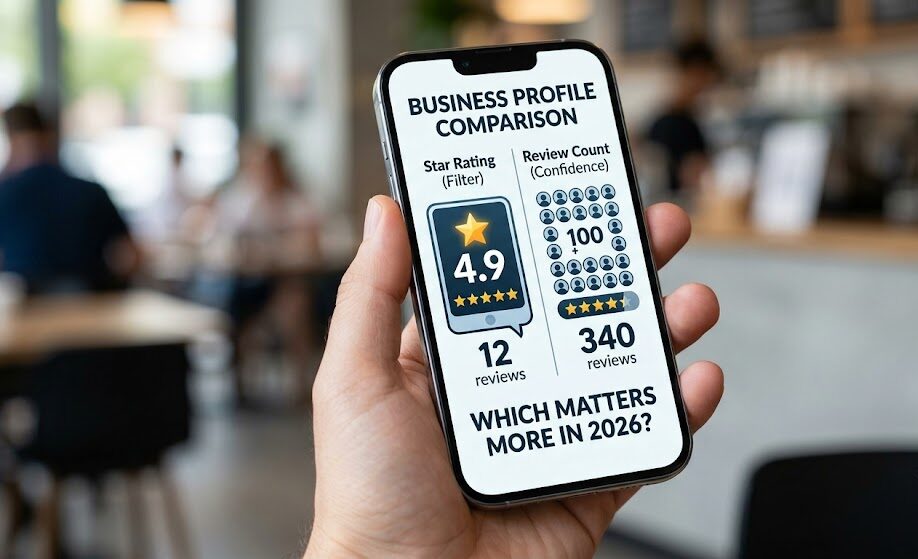
Two businesses can sit side by side in a Google search result with very different profiles. One shows 4.9 stars from 12 reviews. The other shows 4.4 stars from 340 reviews. Deciding which one wins on trust is not as obvious as it first looks, which is exactly why the star rating vs review count question deserves a proper framework rather than a gut instinct. This guide breaks down what customers actually weigh and how a business should prioritise its own growth.
Quick Answer at a Glance
Here is the short version before the full breakdown below.
| Question | Short Answer |
|---|---|
| Which matters more to customers | Both matter. They apply at different stages of the decision rather than as one combined score. |
| Where star rating dominates | The first glance filter, deciding whether a business gets considered at all. |
| Where review count dominates | The confidence check, deciding whether that first impression can be trusted. |
| Riskiest combination | A high rating with very few reviews, since one bad review can swing it sharply. |
| Strongest combination | A high rating with a healthy review count, since both signals reinforce each other. |
Why This Is Not a Simple Either Or Question
Framing this as a competition between two numbers misses how customers actually process them. Star rating and review count answer two different questions in a customer’s mind, not one shared question measured two ways.
Star rating answers roughly how good. Review count answers roughly how sure a customer can be about that number. A customer scanning search results uses both signals together, often without consciously separating them, which is exactly why a business optimising for only one number can end up with a profile that looks strong on paper but weaker in practice.
How Star Rating Works as a First Glance Filter
Star rating is usually the very first thing a customer notices, often before they register the business name properly. It functions as a filter more than a full evaluation, quickly separating businesses worth a closer look from those a customer scrolls past without a second thought.
This filtering effect is strongest at the low end. A rating below roughly 3.5 stars tends to remove a business from consideration entirely for many customers, regardless of how many reviews sit behind it. Above that rough threshold, the filtering effect weakens and other signals start to matter more.
How Review Count Works as a Confidence Check
Once a business clears the initial rating filter, review count shifts to answering a different question. Can this rating actually be trusted. A 4.9 star rating built from 12 reviews carries far less statistical weight than the same 4.9 stars built from 400 reviews.
Customers rarely calculate this consciously. The underlying instinct behind it is sound regardless. A small sample size means a single unusually positive or negative experience can swing the average sharply. A larger sample smooths out individual variation and produces a number closer to the business’s genuine typical experience.
Worked Example: Two Profiles, Same Category, Different Signals
Take two independent cafes in the same UK town. Cafe A shows 4.9 stars from 15 reviews. Cafe B shows 4.4 stars from 280 reviews. On rating alone, Cafe A looks like the clear winner.
A customer reading past the headline number often reaches a different conclusion. Cafe B’s 280 reviews represent a much larger, more diverse sample of actual customer experiences, giving a more statistically reliable picture even at a lower headline number. Cafe A’s small sample could easily shift several tenths of a point with just two or three new reviews in either direction. Neither profile is objectively wrong to trust. They simply represent genuinely different kinds of evidence. A savvy customer often weighs Cafe B’s larger sample more heavily than the raw star number alone would suggest.
The Danger Zone: High Rating, Very Low Review Count
A profile sitting at 5.0 stars from only 3 or 4 reviews is statistically fragile in a way many business owners underestimate. It takes only one dissatisfied customer to drop that rating noticeably. A sudden visible drop after a long stretch at a perfect score can look more alarming to a browsing customer than a steady 4.3 average ever would.
Businesses in this position benefit more from growing review count at a stable rating than from defending a fragile perfect score. A profile that settles into a slightly lower but well supported rating tends to read as more genuinely trustworthy than one balanced precariously on a handful of reviews.
When Review Count Matters More Than Rating
For certain categories, particularly higher consideration purchases like home renovation, legal services or larger trades jobs, customers often specifically look for evidence of consistent track record over a long period rather than a narrowly perfect score.
Working out where your own profile sits against this trade off starts with checking your current numbers through the calculator tool to see the exact gap between where you are and where a stronger combined position would sit.
Building Both Signals Together Rather Than Choosing One
The strongest long term position rarely comes from optimising one number in isolation. A steady stream of new reviews that maintains or gently improves the existing average builds both signals at once, rather than trading one off against the other.
This means resisting the temptation to stop collecting reviews once a strong rating is reached. A profile that plateaus at a good rating with a stagnant review count over many months starts to look dated to customers checking how recently the business has been active, even if the star number itself remains unchanged.
How Local Competition Changes the Calculation
A business competing against several nearby rivals with large, well established review counts faces a different version of this trade off than one with a genuine local monopoly on its specific service. In a crowded market, review count becomes a more visible competitive signal, since customers can compare several similar profiles side by side within seconds.
A business with little direct local competition can afford to weigh review count slightly less heavily, since customers have fewer alternatives to compare against in the first place. Checking what the closest three or four competitors show on both measures gives a far more useful benchmark than any generic industry figure.
A Second Angle: How These Signals Interact With Written Review Content
Star rating and review count are the two headline numbers, though the written content behind them plays a supporting role worth mentioning. A customer who clicks through past the summary numbers often skims a handful of the most recent written reviews before making a final decision.
A profile with a strong rating and healthy review count but thin, generic written reviews can still lose a hesitant customer at this final stage. Specific, detailed written reviews reinforce both headline numbers by giving a customer concrete evidence to match against the summary figures, rather than asking them to trust the numbers alone.
How This Trade Off Shows Up Differently on Mobile Search
Mobile search results often compress the visible information further than a desktop search, showing the star rating and review count prominently while pushing written review content one extra tap away. This makes the two headline numbers carry even more relative weight on mobile, where a large share of local searches now happen.
A business with a strong combined position on both numbers benefits disproportionately from mobile traffic. A hesitant customer scrolling quickly through several map results has less patience to tap into individual reviews before making a snap decision based on the numbers alone.
A Practical Way to Score Your Own Profile
A simple internal scoring exercise helps turn this whole framework into a concrete decision rather than an abstract discussion. List your current rating, your current review count and the same two figures for your three closest competitors side by side in a single table.
Whichever number shows the largest relative gap against those competitors is usually the number worth prioritising first. A business trailing competitors mainly on review count should focus there before chasing further rating improvements that customers may barely notice against an already strong number.
Checklist: Deciding What to Prioritise Right Now
- Check whether your current rating sits above or below the rough 3.5 star filtering threshold for your category.
- If your rating is strong but your review count is very low, prioritise volume over further rating gains.
- If your review count is strong but your rating is mediocre, prioritise rating improvement before adding more volume.
- Compare your numbers against your closest three or four local competitors, not an abstract benchmark.
- Keep collecting reviews steadily even after reaching a strong position, rather than stopping once a target is hit.
- Revisit this comparison every few months as your own numbers and your competitors’ numbers both shift.
How Buy Social Review Fits Into This
Buy Social Review Team: The team helps clients work out which side of this trade off actually needs attention first, rather than defaulting every client to the same generic growth plan.
Once the priority is clear, building toward it with a structured review campaign can close either gap depending on which one matters more for a specific profile.
FAQs About star rating vs review count
Is there an ideal minimum review count before a rating becomes trustworthy?
There is no official threshold, though many customers intuitively treat anything under roughly 20 to 30 reviews as still fairly early evidence, with confidence increasing steadily beyond that range.
Does a lower rating with more reviews ever outperform a higher rating with fewer?
Yes, particularly once the higher rating sits on a very small sample. A customer reading past the headline number often trusts the larger, more consistent sample more.
Should a brand new business focus on rating or review count first?
Review count usually matters more early on, since a brand new profile has no track record at all yet. Even a handful of genuine reviews at a reasonable rating builds more trust than zero reviews at any rating.
Does review count matter differently across different industries?
Yes. Higher consideration categories like trades or professional services tend to weigh review count and consistency more heavily than quick, low risk purchase categories where a customer decides faster.
Can too many reviews ever look suspicious on their own?
Rarely from volume alone, though a sudden unexplained spike in review count without a corresponding rating change can draw more scrutiny than a steadily growing count over time.
Does responding to reviews affect which signal matters more?
Indirectly. Thoughtful responses can reassure a customer weighing a slightly lower rating, adding a layer of trust that neither the star number nor the review count captures on its own.
How quickly can a small business close the review count gap against larger competitors?
It varies by category and effort, though a focused push over a few months can meaningfully narrow the gap for most small local businesses starting from a modest review count.
Does the freshness of reviews matter as much as the total count?
Yes, to a real extent. A large historical review count with no recent activity can read as less current than a smaller but consistently growing recent count.
Should a business ever try to slow down review growth?
Rarely a good strategy. Steady growth almost always reads as healthier than either a stagnant count or an unnaturally fast one. The real goal is consistency rather than deliberately slowing down.
Is star rating or review count more visible in search results themselves?
Both typically display together right next to the business name. Neither signal is hidden from a customer scanning results, which is exactly why both deserve ongoing attention rather than picking one to the exclusion of the other.
Does this trade off change once a business reaches several hundred reviews?
Somewhat. At very high review counts, the rating itself becomes far more statistically stable. Further review count growth matters less than protecting the existing average from a run of negative reviews at that later stage of growth.
Final Thoughts
Star rating vs review count is not a contest with one clear winner. Rating filters who considers a business at all, while review count decides how much that rating can be trusted once a customer looks closer. The strongest position comes from building both together steadily rather than treating one as more important than the other. Checking both numbers regularly against local competitors keeps the priority clear over time. Buy Social Review can help close whichever gap matters most for a specific profile.
Follow Us for More Google Review Tips
If you want more Google Review strategies Local SEO tips and online reputation insights follow our official social media profiles.