
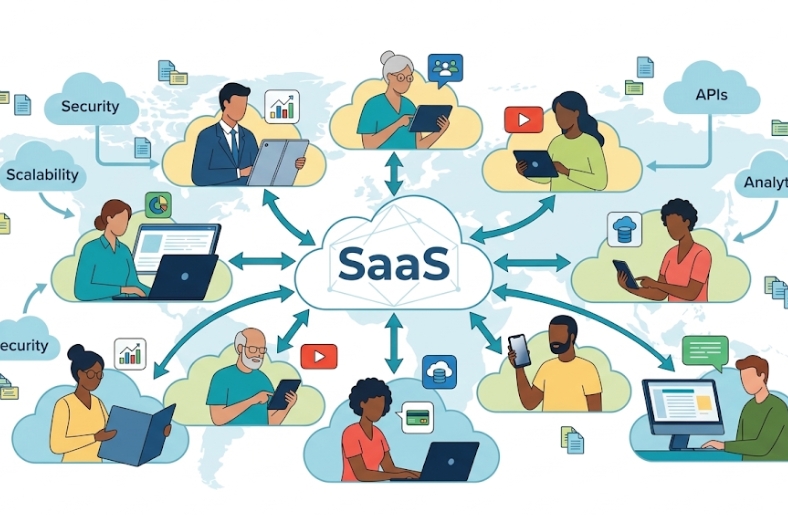
For software companies, organic search can become a powerful source of qualified leads, product signups, demo requests, and recurring revenue. SaaS SEO is the process of optimizing a software company’s digital presence so potential customers can discover its solutions when searching for problems, products, features, comparisons, integrations, and use cases. Unlike many traditional businesses, SaaS companies often have longer buying journeys, multiple decision-makers, free trials, product-led experiences, and recurring revenue models. This means search visibility needs to be connected to the complete customer journey rather than treated simply as a traffic-generation activity.
A successful strategy combines keyword research, technical optimization, content marketing, product pages, comparison pages, internal linking, digital PR, backlinks, conversion optimization, and performance measurement. The objective is to attract the right audience and turn organic visibility into measurable business outcomes.
What Is SaaS SEO?
SaaS SEO refers to search engine optimization specifically designed for software-as-a-service companies. It focuses on making a SaaS website more visible for searches performed by prospective users throughout the buying funnel.
The strategy can target:
- Software category keywords
- Problem-based searches
- Feature-related searches
- Product and solution keywords
- Competitor comparison searches
- Alternative searches
- Integration keywords
- Use-case searches
- Educational topics
- Branded searches
- Transactional software queries
The central difference is intent. Someone searching for “what is project management” may be at the awareness stage, while someone searching for “best project management software for agencies” is much closer to evaluating a solution. Effective organic growth strategies account for these differences rather than publishing content simply because a keyword has high search volume.
Why SaaS SEO Is Important for Software Companies
Software businesses frequently depend on their websites to explain products, demonstrate features, communicate pricing, build trust, and generate trials or demos. Search visibility can therefore influence multiple stages of customer acquisition.
Organic search can help SaaS companies:
- Generate qualified website traffic
- Attract potential customers before they know a specific brand
- Reduce dependence on paid acquisition
- Build topical authority
- Increase product discovery
- Generate free-trial registrations
- Produce demo requests
- Capture comparison searches
- Support brand awareness
- Lower customer acquisition costs over time
The strongest programs measure success beyond sessions and rankings. Metrics such as qualified leads, trials, pipeline, customer acquisition cost, recurring revenue, and customer lifetime value provide a better picture of whether organic search is contributing to business growth.
How SaaS SEO Differs From Traditional SEO
SaaS companies have several characteristics that require a specialized approach.
First, software buyers often conduct extensive research before purchasing. They may compare several vendors, investigate features, read reviews, watch demonstrations, test free versions, and consult other stakeholders.
Second, SaaS websites often contain many specialized page types, including:
- Product pages
- Feature pages
- Integration pages
- Industry pages
- Use-case pages
- Comparison pages
- Alternative pages
- Documentation
- Templates
- Resource pages
- Pricing pages
Third, SaaS businesses typically care about recurring revenue rather than one-time transactions. Consequently, attracting a visitor is only the beginning. The goal is to acquire visitors who have a realistic chance of becoming retained customers.
SaaS Keyword Research and Search Intent
Keyword research should begin with the problems the software solves rather than simply starting with product terminology.
A comprehensive keyword universe can include:
Problem-aware keywords: searches describing a challenge or pain point.
Solution-aware keywords: searches indicating that the user understands the type of solution needed.
Product-category keywords: searches for a particular software category.
Feature keywords: searches for specific capabilities.
Comparison keywords: searches comparing two or more products.
Alternative keywords: searches looking for competitors or substitutes.
Integration keywords: searches involving connections between software platforms.
Use-case keywords: searches describing how software is used in a particular business context.
Branded keywords: searches involving the company or its product.
Backlinko, Ahrefs, and Semrush all emphasize mapping keywords to the customer journey and identifying opportunities across informational, commercial, transactional, and navigational intent.
Bottom-of-Funnel Keywords for SaaS Growth
Many SaaS teams make the mistake of beginning with broad informational content. While educational articles can generate awareness, bottom-of-funnel searches often have stronger commercial value.
Examples include:
- Best CRM for startups
- Accounting software for small businesses
- [Competitor] alternatives
- [Product A] vs [Product B]
- Best project management platform
- Marketing automation software
- Software for remote teams
These searches indicate that the user is actively evaluating solutions. Comparison pages, alternative pages, product pages, pricing content, integration pages, and use-case landing pages can therefore be valuable components of an organic acquisition strategy.
SaaS Website Architecture and Internal Linking
A clear website structure helps users and search engines understand the relationship between different sections.
A SaaS website might follow a structure such as:
Homepage → Product → Features → Use Cases → Industries → Resources
Supporting content can then link naturally toward relevant commercial pages.
For example, an article about customer retention could link to a relevant customer-success feature page. An integration guide could link to the product’s integration hub. A comparison article could connect to a demo or pricing page.
Internal linking should be intentional rather than excessive. Descriptive anchor text, logical navigation, breadcrumbs, related resources, and contextual links can make important pages easier to discover while distributing internal authority across the website.
Product-Led SEO Strategy
Product-led SEO uses the actual software product, its capabilities, or supporting resources to create search experiences that attract and convert users.
Examples include:
- Free tools
- Calculators
- Templates
- Generators
- Interactive resources
- Public product pages
- Documentation
- Integration directories
- Programmatic landing pages
Ahrefs highlights free tools, product-led content, programmatic approaches, original data, and international expansion as potential growth opportunities for SaaS companies.
A free tool can be particularly valuable because it provides immediate utility rather than simply presenting promotional information. If users find it useful, it can also generate links, mentions, returning visitors, and potential product adoption.
SaaS Content Marketing and Topic Clusters
Content should establish expertise around the problems and subjects connected to the product.
A topic cluster can include:
- One comprehensive pillar page
- Supporting educational articles
- How-to guides
- Comparison articles
- Use-case content
- Industry-specific resources
- FAQs
- Product-focused pages
For example, a cybersecurity SaaS company could build a content ecosystem around endpoint protection, including educational guides, implementation resources, software comparisons, compliance content, and product documentation.
The purpose is not to publish hundreds of unrelated articles. Content should reinforce topical relevance and create logical pathways from informational searches to commercial pages.
Comparison and Alternative Pages
Comparison and alternative pages can be particularly valuable because they target users who are already considering software solutions.
Useful formats include:
- Product A vs Product B
- Product A alternatives
- Best alternatives to Product A
- Product A competitors
- Product A pricing comparison
- Product A features compared
These pages should be factual and transparent. Artificially criticizing competitors or making unsupported claims can damage credibility. A strong comparison should clearly explain differences in features, pricing, usability, integrations, support, target audience, and appropriate use cases.
Technical SEO for SaaS Websites
Technical SEO provides the foundation for organic visibility.
Important areas include:
Crawlability
Search engines need to access important pages efficiently. Review robots.txt, XML sitemaps, internal links, redirects, status codes, and crawl paths.
Indexation
Not every URL needs to appear in search results. SaaS sites may create unnecessary URLs through application functionality, parameters, internal search, filters, or duplicate templates.
JavaScript SEO
Modern SaaS websites often use JavaScript frameworks. Rendering and crawlability should be tested carefully to ensure important content and links are accessible to search engines.
Site Speed
Slow pages can negatively affect user experience. Optimize images, scripts, fonts, server response times, caching, and unnecessary third-party resources.
Mobile Experience
The website should remain easy to navigate and interact with across smartphones and tablets.
Technical SEO should be monitored continuously because SaaS websites frequently change as new features, integrations, pricing pages, documentation, and product experiences are introduced.
SaaS Link Building and Digital PR
Authority building remains an important component of organic search.
Relevant link-building opportunities can include:
- Industry publications
- Software directories
- Expert commentary
- Original research
- Digital PR
- Data studies
- Product reviews
- Partner websites
- Integration partners
- Industry resources
- Founder interviews
Original research can be particularly useful because proprietary statistics and industry insights provide journalists, bloggers, and researchers with reasons to reference a source.
The goal should be earning relevant, credible mentions rather than acquiring large numbers of low-quality links.
Programmatic SEO for SaaS
Programmatic SEO involves creating large numbers of useful pages from structured data and templates.
For SaaS companies, possible applications include:
- Integration pages
- Industry pages
- Location-specific solutions
- Use-case pages
- Comparison combinations
- Software directories
- Template libraries
However, scale should not come at the expense of quality. Automatically generated pages that provide little unique information can create thin-content problems and offer limited value to users.
Programmatic pages should therefore exist only where there is genuine user demand and where each page can provide meaningful information.
SaaS SEO for Documentation and Help Centers
Documentation can represent an overlooked organic-search opportunity.
Users frequently search for:
- How to use a software feature
- API documentation
- Integration instructions
- Configuration steps
- Troubleshooting solutions
- Product specifications
- Technical requirements
Well-organized documentation can capture these searches while simultaneously helping existing customers. It can also reduce friction during product evaluation because prospects can see how the software works before purchasing.
International SaaS SEO
SaaS companies often have global audiences, making international search visibility another potential growth channel.
International optimization may involve:
- Country-specific pages
- Language-specific content
- Hreflang implementation
- Regional keyword research
- Localized pricing information
- Country-specific product positioning
- Translated documentation
Translation alone is not always sufficient. Search behavior, terminology, purchasing expectations, regulations, and competition can differ between markets.
Measuring SaaS SEO Performance
A mature reporting system should connect search visibility with revenue outcomes.
Important metrics include:
- Organic clicks
- Organic impressions
- Keyword rankings
- Click-through rate
- Non-branded traffic
- Product-page traffic
- Trial registrations
- Demo requests
- Marketing-qualified leads
- Sales-qualified leads
- Conversion rate
- Customer acquisition cost
- Monthly recurring revenue
- Customer lifetime value
- Churn
- Pipeline generated from organic search
Traffic should be evaluated according to quality. A page generating 10,000 visitors who never become customers may be less valuable than a page generating 500 highly qualified visitors.
Semrush specifically recommends establishing goals and KPIs before executing a strategy and using performance data to refine keyword targeting, content, technical improvements, and authority-building activities.
Common SaaS SEO Mistakes
Several mistakes can limit organic growth:
- Publishing content without understanding search intent
- Focusing exclusively on high-volume keywords
- Ignoring bottom-of-funnel opportunities
- Creating too many low-value blog posts
- Neglecting product and feature pages
- Publishing weak comparison pages
- Ignoring technical SEO
- Allowing JavaScript issues to block important content
- Creating duplicate or thin pages
- Building low-quality backlinks
- Measuring traffic instead of revenue
- Ignoring documentation as a search asset
- Failing to update outdated content
- Neglecting internal linking
- Creating programmatic pages without unique value
Avoiding these problems helps ensure that organic search supports actual business objectives instead of becoming a publishing exercise.
AI Search and the Future of SaaS Visibility
Search is increasingly expanding beyond traditional blue-link results. AI-generated answers and conversational search experiences are changing how users discover information and products.
For SaaS companies, this makes clear information architecture, authoritative content, structured data, original research, technical accessibility, and consistent brand information increasingly important. Recent industry discussions also emphasize the emerging relationship between traditional SEO and generative engine optimization as AI-powered search becomes a larger part of discovery.
Rather than treating AI visibility as completely separate from search optimization, companies can focus on producing accurate, useful, well-supported information that search engines and answer systems can understand.
Frequently Asked Questions
What is SaaS SEO?
It is a search optimization approach designed specifically for software-as-a-service businesses. It focuses on attracting qualified prospects through searches related to problems, software categories, features, comparisons, integrations, use cases, and products.
Why is SEO important for SaaS companies?
SEO can help software companies attract prospects who are actively researching solutions, generate trials and demos, build authority, and create a sustainable acquisition channel. Its effectiveness should ultimately be evaluated through qualified leads, customers, pipeline, and revenue rather than traffic alone.
How do I create an SEO strategy for a SaaS company?
Start by defining the ideal customer profile and business goals. Research keywords according to search intent and funnel stage, prioritize high-value commercial pages, build useful supporting content, improve technical SEO, strengthen internal linking, earn relevant authority, and measure organic performance against conversions and revenue.
What keywords should SaaS companies target?
SaaS companies should target a combination of product-category, problem-aware, feature, use-case, comparison, alternative, integration, branded, and informational keywords. High-intent terms should receive particular attention because they can be closer to conversion.
How long does SaaS SEO take to work?
There is no universal timeline. Results depend on domain authority, competition, technical condition, content quality, search demand, backlinks, implementation speed, and the age of the website. SEO generally requires consistent work rather than a one-time optimization.
What type of content works best for SaaS SEO?
High-value content can include product pages, feature pages, comparison pages, alternative pages, integration pages, use-case pages, templates, free tools, documentation, buying guides, and educational articles. The best format depends on the search intent and stage of the buyer journey.
Is SEO better than paid advertising for SaaS?
They serve different purposes. Paid advertising can provide immediate traffic, while organic search can develop a compounding acquisition channel over time. Many SaaS businesses can benefit from using both, with SEO supporting long-term visibility and paid campaigns supporting immediate demand generation.
What should I measure in SaaS SEO?
Measure organic traffic, rankings, impressions, clicks, conversions, trials, demos, qualified leads, pipeline, customer acquisition cost, recurring revenue, lifetime value, and retention. Connecting organic performance to commercial outcomes provides a more useful assessment than rankings alone.
Conclusion
SaaS SEO works best when organic search is treated as a complete acquisition system rather than a collection of blog posts and keywords. The strongest strategy connects search intent with the buyer journey, prioritizes commercially valuable pages, establishes topical authority, maintains a technically accessible website, and continuously measures the relationship between organic visibility and revenue.
Software companies should begin with their ideal customers and the problems those customers are trying to solve. From there, they can develop keyword clusters, build product-led resources, create comparison and use-case pages, strengthen internal linking, optimize technical foundations, earn authoritative mentions, and improve conversion paths. As search increasingly incorporates AI-generated answers and new discovery experiences, useful content, trustworthy information, strong technical foundations, and clear product positioning will remain central to sustainable organic growth.