
Search this topic for five minutes and you will find two completely opposite answers. One camp insists every purchased review gets caught eventually. The other insists it never happens if you know what you are doing. Neither answer is quite right. Will buying google reviews get you suspended depends far more on how the reviews are sourced and paced than on the simple fact that money changed hands. This guide breaks down exactly what Google’s detection systems actually look for, what a suspension looks like in practice and how the risk scales with volume and method.
Quick Answer at a Glance
Here is the short version before the detail.
| Question | Short Answer |
| Can buying reviews trigger a suspension | Yes. Risk scales sharply with sourcing and pacing rather than the purchase itself alone |
| Biggest single risk factor | A burst of reviews landing in hours instead of spread across days or weeks |
| Second biggest risk factor | Reviews from freshly created or clearly inactive Google accounts |
| Lowest risk approach | Real, active accounts with genuine posting history, delivered gradually |
| Worst case outcome | Profile suspension, which can remove a business from Maps and Search for months |
How Google’s Detection System Actually Works
Google does not read every review with a human eye. Detection runs largely on pattern matching across four layers: posting velocity, account trust history, language similarity and geographic or device signals tied to the reviewer’s account.
Each layer produces its own risk score. The review or the batch of reviews gets flagged when several scores cross a threshold together rather than any single one alone. A brand new account posting a single review rarely triggers anything. Twenty brand new accounts posting within the same hour, using similar sentence structure, is a very different signal to the same system. Automated systems like this are built to catch patterns across thousands of profiles at once, which is exactly why an isolated, well paced order tends to pass unnoticed while a rushed one does not.
The Four Signals That Trigger the Most Scrutiny
Velocity comes first. A profile that gains one or two reviews a month suddenly picking up thirty in a single day creates an obvious statistical anomaly against its own history.
Account trust history comes second. Google weighs how long an account has existed, whether it has reviewed other businesses over time and whether it shows normal usage such as saved places or photo uploads. A dormant account created the same week it posts a review carries far less trust than one with years of ordinary activity behind it.
Language similarity is third. Reviews that reuse near identical phrasing across unrelated businesses, even with a word or two swapped, cluster together in Google’s systems regardless of which business profile they landed on. Geographic and device signals round out the fourth layer, flagging accounts that post reviews for businesses far outside any location they have ever interacted with. A reviewer account based in one country suddenly rating a small shop on the other side of the world, with no other connection to that region, is exactly the kind of mismatch this layer is built to catch.
Worked Example: Two Orders, Two Outcomes
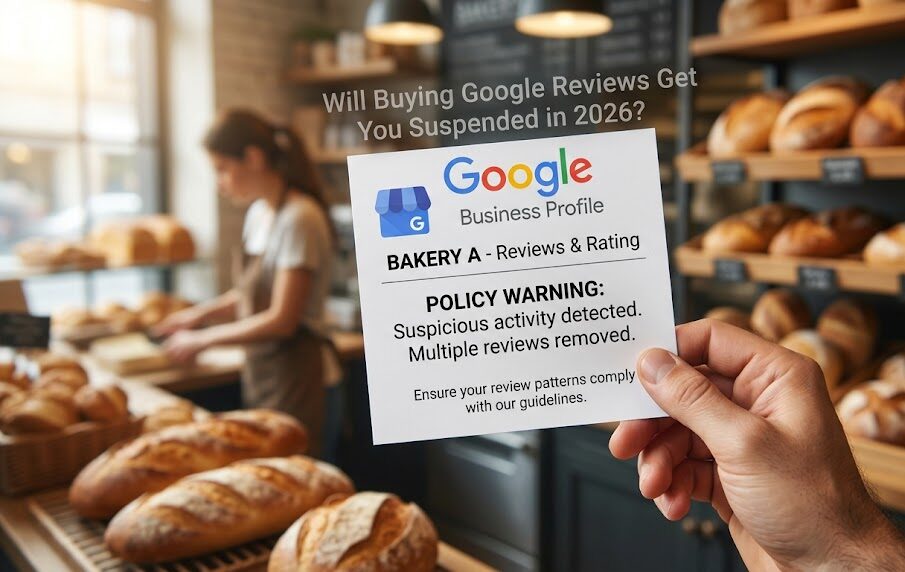
Take two identical local bakeries, each ordering fifty new reviews. Bakery A orders through a service that delivers all fifty within a single afternoon from accounts created that same week, each review using near identical wording about fresh bread and friendly staff.
Bakery B orders the same fifty reviews through a service that spreads delivery across six weeks, drawing from real accounts with years of unrelated review history, each review written with distinct wording and detail. Within a month, Bakery A’s entire batch gets removed and the profile receives a policy warning. Bakery B’s reviews remain live with no action taken. This example is illustrative, built to show how pacing and sourcing change the outcome rather than describing a specific verified case.
What Suspension Actually Looks Like, Step by Step
A first violation rarely jumps straight to a full suspension. The more common first step is a silent removal of the flagged reviews, sometimes without any notification reaching the business owner at all.
Repeated or larger scale violations escalate further, sometimes to a warning banner on the profile itself and, in more serious or repeated cases, to a temporary or permanent suspension that removes the entire Business Profile from Google Maps and Search. A suspended profile stops appearing in local search results entirely, which for a business relying on local discovery can mean a sharp drop in calls and visits within days of the suspension taking effect.
The scale of the response usually tracks the scale of the violation. A single flagged review from an otherwise normal profile rarely escalates past a quiet removal. A profile with repeated flags across several months builds a pattern that Google’s systems weigh more heavily each time, which is part of why a single risky order can carry consequences well beyond the reviews it directly affected.
Does the Number of Reviews You Buy Change the Risk
Volume matters. It is not the whole story on its own. A small order of five or ten reviews, paced over a week or two from established accounts, sits at meaningfully lower risk than a large order of two hundred delivered in a weekend, even though the small order is objectively still paid content.
Larger volume orders are not inherently unsafe. They simply need proportionally longer delivery windows to avoid the velocity signal described earlier. Reviewing package options built around gradual, real account delivery is worth doing before assuming a bigger order automatically means bigger risk.
Recovering From a Suspension: What the Process Involves
Reinstatement starts with an appeal through Google’s own support channels, explaining the circumstances and, where relevant, committing to compliant practices going forward. Google typically asks for confirmation that any policy violating content has been addressed before considering reinstatement.
The process commonly takes several weeks and sometimes stretches past two months for more serious cases. During that entire window the business has no visible presence on Maps or in local Search results, which is the real cost of a suspension beyond the reviews themselves.
How Drip Fed, Real Account Delivery Reduces Risk
The mechanics behind lower risk delivery are straightforward once you understand what the detection layers are actually checking. Spreading delivery across days or weeks avoids the velocity spike. Using accounts with genuine, varied posting history avoids the trust score problem. Writing distinct wording for each review avoids the language clustering signal.
None of this makes the practice risk free, since Google’s policies still prohibit incentivized or fabricated engagement regardless of how carefully it is delivered. It does mean the difference between a method built around detection mechanics and one that ignores them entirely. That difference shows up clearly in outcomes like the worked example above.
UK Specific Regulatory Context in 2026
Beyond Google’s own platform rules, UK businesses now sit inside a tighter regulatory environment around fake reviews. The Digital Markets, Competition and Consumers Act 2024 introduced specific rules banning fake and misleading reviews, giving the Competition and Markets Authority direct enforcement powers rather than relying solely on platform self policing.
This shifts the calculation for UK businesses specifically. A flagged review is no longer only a platform problem. It sits inside a wider consumer protection framework where repeated or deliberate manipulation can draw regulatory attention separate from whatever Google itself decides to do about a profile.
Checklist: Reducing Suspension Risk Before You Buy
- Choose gradual delivery over a single large batch landing at once.
- Confirm reviews come from real, active accounts with genuine posting history.
- Ask for varied wording across reviews rather than a repeated template.
- Match delivery pace to your profile’s normal review volume rather than a fixed generic schedule.
- Keep a record of what was ordered and when in case a question ever comes up.
- Balance any paid reviews with a genuine ongoing request strategy rather than relying on one method alone.
How Buy Social Review Fits Into This
Buy Social Review Team: The team builds every order around the same detection mechanics covered in this guide, using real active accounts and gradual, drip fed delivery timed to look like normal organic growth rather than a sudden spike.
For the fuller picture of how a safer buying process works end to end, the general guide to buying reviews safely covers the process from order to delivery. Checking package pricing is the next step once you have decided on a delivery pace that fits your profile.
FAQs About will buying google reviews get you suspended
Does a single suspicious review trigger a full profile audit?
Rarely on its own. A single flagged review usually just gets removed. A full audit tends to follow a pattern across multiple reviews or repeated violations rather than one isolated flag.
Can competitors report reviews to trigger a suspension?
Yes. A competitor can report reviews they suspect are fake. Google investigates the underlying claim regardless of who filed it. The report itself does not cause a suspension. The evidence behind it does.
Does the reviewer’s account age matter more than the review content?
Both matter. Account age and history carry significant weight in the trust scoring layer. A well written review from a brand new account still looks riskier to the system than a similar review from an established one.
Is there a way to check if a profile is already at risk before ordering more reviews?
There is no official risk checker from Google. Reviewing your existing review velocity and account mix against the signals covered in this guide gives a reasonable estimate before adding to the profile.
Does buying reviews for a brand new profile carry more risk than an established one?
Often yes, since a brand new profile has no baseline history to smooth out a sudden spike. Established profiles with years of organic reviews have more room to absorb new activity without it standing out statistically.
Can a suspension happen even if every review is genuinely positive?
Yes. Suspension risk is tied to how reviews were sourced and delivered, not whether the sentiment expressed is positive or negative. A glowing review from a fabricated account still breaks the same policy.
Does responding to reviews reduce suspension risk?
Not directly. Responding shows engagement and builds trust with customers. It does not factor into the detection signals covered here, which focus on the reviews and accounts themselves rather than owner replies.
How quickly does Google typically flag a suspicious burst of reviews?
It varies, though sudden spikes are often caught within days rather than weeks, since velocity is one of the fastest signals for automated systems to detect compared with slower pattern analysis like language clustering.
Does a past suspension make future review activity riskier?
It can. A profile with a suspension history may receive closer ongoing scrutiny, which is another reason to prioritise gradual, well sourced delivery going forward rather than repeating whatever caused the original flag.
Does the type of business affect how closely a profile gets watched?
To some extent. Categories that see heavier review manipulation overall, such as restaurants and trades, tend to sit under closer general scrutiny than lower volume categories, simply because the wider pattern across that category attracts more attention from Google’s systems.
Should a business avoid buying reviews altogether given the risk?
Not necessarily. The risk described throughout this guide is manageable rather than fixed, since it responds directly to sourcing and pacing choices. A business that treats the detection mechanics seriously and chooses a gradual, real account approach faces a very different risk profile than one that chases the fastest possible batch.
Final Thoughts
Will buying google reviews get you suspended comes down almost entirely to method rather than the act itself. A sudden burst from fresh, low trust accounts is where nearly all the real risk sits. Gradual delivery from genuine, active accounts with varied wording changes the picture considerably. Buy Social Review builds every order around exactly these detection mechanics so the risk stays as low as the method allows.
Follow Us for More Google Review Tips
If you want more Google Review strategies Local SEO tips and online reputation insights follow our official social media profiles.