
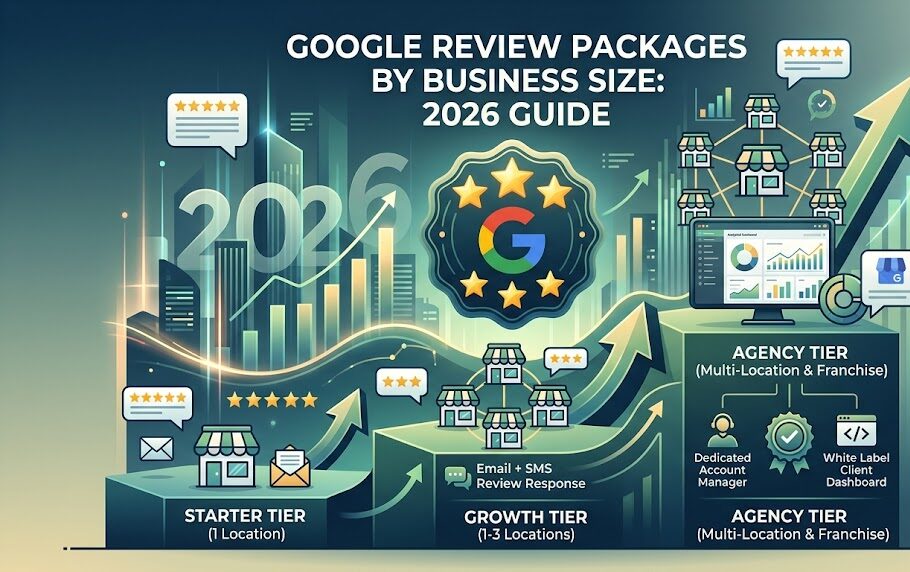
Picking a package by price alone is how a single café ends up on a plan built for a five location franchise. It is also how a growing chain gets stuck on a starter tier that runs out within a month of ordering. The right google review package by business size decision starts with location count and monthly customer volume, not the number on the price tag. This guide walks through how to size the decision properly, using the actual tier structure rather than guesswork. It also covers where agencies managing several client accounts fit into the same logic.
Quick Answer at a Glance
Here is the short version before the detail.
| Business Size | Likely Fit |
|---|---|
| Single location, just starting out | Starter tier, small initial batch to build a baseline. |
| One location, steady footfall | Growth tier, ongoing monthly requests plus SMS. |
| Two to three locations | Growth tier scaled up or the lower end of Agency. |
| Franchise or multi location brand | Agency tier with a dedicated account manager. |
| Sizing rule of thumb | Match the package to location count and monthly new customers, not just budget. |
Why Business Size Should Drive the Decision, Not Price
A package priced lower always looks appealing on paper. The trouble starts when a business with three locations tries to run all of them through a plan built for one, since review requests, response management and reporting all multiply with each additional location.
Business size, in the context of choosing a package, means three things together: how many physical or service locations need reviews, how many customers pass through each location monthly and whether reviews need managing centrally or by an individual site. Getting this wrong in either direction wastes money, either by overpaying for capacity a single shop will never use or by underpaying and running out of review capacity halfway through a campaign. A business that skips this sizing step tends to discover the mismatch only after the first invoice, which is the expensive way to learn it. Working through the sizing questions before ordering, rather than after the first month’s results come in, saves both money and time.
The Three Tiers, Mapped to Real Business Situations
Starter: One Location, Early Stage
Starter fits a single location business that has never run a structured review push before. It typically covers a small initial batch, delivered from real active accounts rather than freshly created ones, enough to establish a baseline rating before deciding whether to scale up.
Growth: One Location Doing Well or Two to Three Locations
Growth is built for a business already generating steady footfall or a small multi location operation such as a pair of salons or a three branch trades business. It adds SMS requests alongside email and includes review response management, which matters once volume grows past what an owner can reply to manually.
Agency: Multi Location Brands and Franchises
Agency is built for businesses managing reputation across several distinct locations at once, such as a franchise group or a multi site retail chain. It includes a white label client dashboard and a dedicated account manager, features that only earn their keep once there are multiple profiles to track side by side.
Worked Example: Sizing a Three Location Trades Business
Take a plumbing and heating company running three vans across two postcodes, each with its own Google Business Profile. Each location handles roughly 25 completed jobs a month, giving a combined pool of about 75 potential reviewers monthly across the group. Before sizing anything, the owner listed each location’s job count separately rather than guessing at a group average, since one branch ran nearly double the volume of the other two.
Running each location on an individual Starter plan would mean managing three separate small batches by hand, with no shared reporting. Sizing the decision against location count and combined monthly volume instead points toward Growth scaled across all three profiles or the lower end of Agency once reporting needs to roll up centrally. Checking the exact tier breakdown on the pricing page against this kind of combined volume is the fastest way to confirm which side of that line a specific business actually sits on.
What the Per Review Volume Table Actually Shows
Beyond the three named tiers, the site’s per review pricing table lets a business scale a single order by exact quantity rather than a fixed package name. Fifty reviews runs $350, one hundred runs $700 and the table continues up to 500 reviews at $3,500 for businesses that need a large single push rather than an ongoing monthly plan.
This volume table is worth checking alongside the named tiers because it changes the sizing question slightly. A single large one off campaign, such as recovering from a bad quarter, might suit a specific quantity order better than a recurring monthly package, even for a business that would otherwise fit the Growth tier by location count alone. The two pricing structures are not competing options. They answer different questions: one sizes an ongoing programme, the other sizes a single push.
How Agencies Managing Several Client Accounts Should Size Differently
Marketing agencies and consultants reselling review growth to their own clients face a sizing question the named tiers do not fully answer on their own. A single agency might handle one client with two locations and another client with a single struggling shop, all under one relationship.
The practical approach is to size each client account on its own merits using the same location and volume logic covered above, rather than forcing every client onto one shared tier for the agency’s own convenience. A white label dashboard becomes genuinely useful once an agency is juggling more than two or three client accounts at once, since it consolidates reporting without needing to log into a separate profile for every single client. Below that threshold, the reporting overhead of Agency tends to outweigh the benefit. Agencies that size client by client rather than defaulting everyone to one tier tend to keep margins healthier across the whole client book.
When a Franchise Needs More Than One Package
A franchise with locations at very different growth stages does not always fit neatly into one tier. A flagship site with years of trading history and a brand new branch that opened last month have different starting points, even under the same parent brand.
Splitting a franchise group across two tiers, running mature locations on Growth while a newly opened branch starts on Starter, is a legitimate approach rather than a compromise. The alternative, forcing every location onto Agency from day one regardless of readiness, usually means paying for reporting depth that a brand new branch does not yet need. Revisiting the split every few quarters as newer branches mature keeps the overall spend matched to where each location actually stands.
Signs You Have Outgrown Your Current Package
A few practical signals suggest it is time to move up a tier rather than staying put out of habit.
Review requests going out consistently faster than the monthly allocation covers is the clearest signal. A second location opening under the same profile management is another. So is spending more owner time than expected on manual response management, which the Growth and Agency tiers are built to absorb. A fourth signal worth watching is reporting confusion, where an owner or manager can no longer easily tell which location is driving which result without pulling several separate exports together by hand. Any one of these signals on its own is worth a second look at the current tier rather than waiting for all four to show up at once.
Checklist: Choosing the Right Package by Business Size
- Count your total active locations, not just your flagship site.
- Estimate combined monthly customer volume across every location together.
- Decide whether reporting needs to roll up centrally or can stay per location.
- Check the per review volume table for one off campaigns rather than assuming a monthly package fits every situation.
- Consider splitting a franchise group across two tiers if locations are at different growth stages.
- Revisit the package choice every few months rather than assuming the first pick fits forever.
How Buy Social Review Fits Into This
Buy Social Review Team: The team works with everything from a single independent shop through to multi site franchise groups and reselling agencies, sizing each package against actual location count and monthly volume rather than pushing every business toward the same plan.
If you are still weighing tiers against your specific setup, comparing the full package breakdown is the fastest way to confirm a fit before ordering. For a wider look at how the buying process itself works once a tier is chosen, the general buying guide covers the mechanics end to end.
FAQs About google review package by business size
Can I switch packages later if my business grows?
Yes. Moving from Starter to Growth or from Growth to Agency is a normal part of scaling and does not require cancelling an existing order first. Most businesses upgrade once volume starts outpacing the current tier’s allocation. The switch itself is usually a quick conversation rather than a fresh onboarding process.
Does the Agency tier only make sense for franchises?
Franchises are the clearest fit. Any business managing several distinct Google Business Profiles under one reporting umbrella, such as a multi site dental group, a regional retail chain or an agency reselling to multiple clients, tends to get similar value from the tier.
What if my locations are in different countries, not just different UK cities?
Package sizing still works the same way by location count and volume. Geo targeting for reviews works at the individual profile level regardless of how many countries the wider group spans. The tier decision does not change based on geography alone.
Is there a minimum number of locations required for the Agency tier?
No fixed minimum applies. Most businesses that choose Agency have at least two or three locations, since that is typically the point where centralised reporting starts saving more time than it costs each month.
Should a seasonal business size its package differently?
Yes. A seasonal business often benefits from scaling up during its busy months and dropping to a smaller tier or a one off volume order during quieter periods, rather than paying for peak capacity all year round regardless of actual footfall.
Do all three tiers include the same review quality standard?
Yes. Every tier draws from real, active Google accounts rather than bots or freshly created profiles. The tiers differ in volume, reporting depth and location count, not in the underlying quality of each review that lands on the profile.
How do I know if I am underusing a package I already pay for?
Check whether the monthly review allocation is being fully used each cycle. Consistent leftover capacity month after month is a sign that a smaller tier or a one off volume order instead of an ongoing plan might fit better for the current stage of the business.
Can a single location ever need the Agency tier?
Rarely. It happens with very high footfall businesses managing an unusually large volume of customer interactions monthly. In most single location cases, Growth covers this level of activity without needing Agency’s multi site reporting features.
Does package size affect how natural the review growth looks?
Not directly. Delivery pacing, not package size, controls how natural the growth pattern looks. A larger package simply allows that same steady pacing to run across more reviews or more locations at once, rather than changing the pacing logic itself.
Final Thoughts
Sizing a google review package by business size decision correctly comes down to counting locations honestly, estimating combined monthly volume and matching that against the tier structure rather than the price tag alone. Starter suits a single business just getting going. Growth covers steady single locations and small multi site setups. Agency is built for franchises, larger groups and agencies managing several client accounts that need centralised reporting. Buy Social Review can help confirm the right fit before you commit to a plan that outgrows itself in a month or sits mostly unused.
Follow Us for More Google Review Tips
If you want more Google Review strategies Local SEO tips and online reputation insights follow our official social media profiles.