
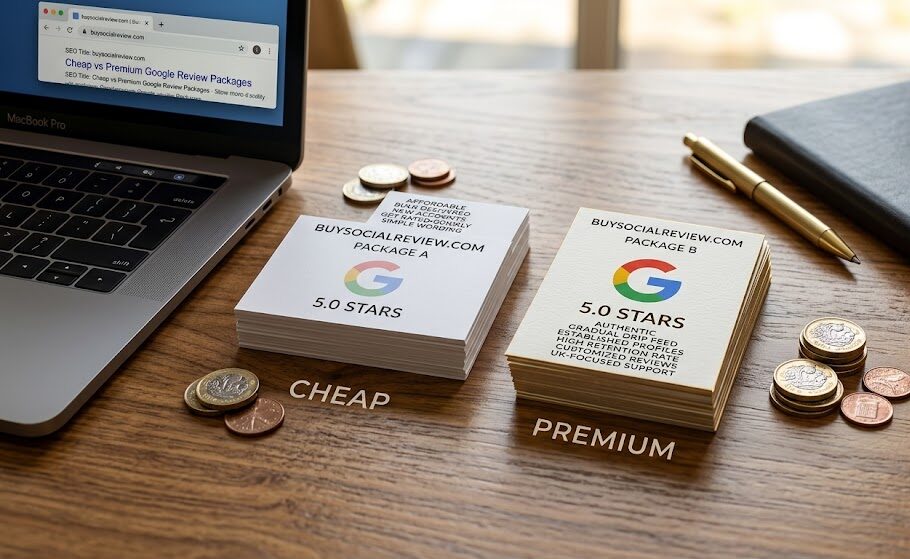
Two providers can quote wildly different prices for what looks like the same product on paper, a batch of five star Google reviews. The difference rarely comes down to profit margin alone. Comparing cheap vs premium google review packages properly means looking past the headline number toward account quality, delivery pacing and how much support sits behind the order once it is placed. This guide breaks down exactly what separates the tiers and which trade offs actually matter for a UK business.
Quick Answer at a Glance
Here is the short version before the full comparison below.
| Factor | Cheap Packages | Premium Packages |
|---|---|---|
| Account quality | Often newer, lower trust accounts. | Established, active accounts with genuine history. |
| Delivery pacing | Frequently rushed or bulk delivered. | Gradual, drip fed to look organic. |
| Review wording | Templated, repeated phrasing common. | Distinct wording written per review. |
| Retention rate | Higher risk of later removal. | Generally more stable over time. |
| Support and guarantees | Minimal or none. | Replacement guarantees and ongoing support common. |
Why Two Packages With the Same Review Count Can Cost So Differently
A package price mostly reflects what goes into sourcing and delivering the reviews rather than the reviews themselves as a product. Genuine, active reviewer accounts cost more to access than freshly created ones. Careful, staggered delivery takes longer to manage than a single bulk drop. Distinct, individually written reviews take more effort than a rotating template.
Every one of those inputs adds cost on the provider’s side, which is exactly why a rock bottom price often signals which corners got cut rather than simply reflecting a leaner, more efficient operation.
What Cheap Packages Typically Get Wrong
The most common problem with a cheap package is account quality. Reviews sourced from accounts created specifically for the order, with no other posting history, carry a much higher detection risk than reviews from accounts with years of ordinary activity behind them.
Bulk delivery timing compounds the problem. A cheap provider often delivers the full batch within hours to keep turnaround fast and costs low, which is precisely the velocity pattern that tends to draw scrutiny. Repeated or near identical wording across the batch adds a third risk layer on top of the first two, since Google’s systems specifically look for clustered language across unrelated profiles.
What Premium Packages Actually Pay For
A premium package is not simply the same product with a bigger price tag attached. It pays for genuine account sourcing, deliberate pacing spread across days or weeks and individually written review text rather than a shared template.
It often includes a stated retention or replacement guarantee too, covering reviews that get removed within an agreed window. Reviewing how a safer buying process works end to end shows where these premium tier practices fit into the wider order process.
Worked Comparison: Two Providers, Same Review Count
Take two providers each offering a batch of 40 reviews. Provider A prices the batch low and delivers all 40 within a single day from newly created accounts using near identical five word phrases about friendly staff.
Provider B prices the same batch considerably higher and spreads delivery across three weeks, drawing from established accounts with genuine posting history, each review written with distinct detail about the specific service received. Within two months, a meaningful share of Provider A’s batch typically gets flagged and removed, while Provider B’s batch tends to remain stable. The lower headline price on Provider A’s batch becomes misleading once the effective cost per surviving review is calculated after removals. This comparison is illustrative, built to demonstrate the mechanics rather than describing a specific verified case.
When a Cheaper Package Genuinely Makes Sense
Price is not automatically a red flag on its own. A smaller, well established provider with lower overheads can sometimes offer a fair price without cutting the corners that matter, particularly for smaller order sizes where the sourcing and pacing effort scales down naturally.
The distinction worth checking is not the price alone but whether the provider can clearly explain their account sourcing and delivery pacing when asked directly. A provider unwilling or unable to answer those specific questions is a stronger warning sign than price by itself.
Questions Worth Asking Before Comparing Price Tags
A short set of direct questions separates a genuinely fair priced provider from one simply cutting corners. Asking about typical account age, delivery timeline and whether wording is written per review rather than templated reveals far more than the price alone ever could.
A provider that answers these questions specifically, with real numbers and timelines, is generally more trustworthy than one that responds with vague reassurance regardless of what tier is being discussed.
How Delivery Pacing Actually Shows Up in the Detail
Pacing sounds like a minor logistics detail until it is broken down into what it actually means for a business profile. A cheap package delivering forty reviews inside six hours produces a spike on the profile’s own review history that stands out sharply against whatever normal organic pace existed before.
A premium package spreading the same forty reviews across three or four weeks produces a pattern that sits much closer to a business simply having a genuinely good month, with a handful of new reviews landing every few days rather than in a single cluster. The visible difference between the two patterns is exactly what separates a batch that draws scrutiny from one that mostly does not.
A Note on Review Content Quality, Not Just Account Quality
Account quality gets most of the attention in this comparison, though review content quality deserves its own mention. A premium provider typically briefs each reviewer on specific, plausible details relevant to the business, such as a particular service, product or aspect of the experience, rather than a generic compliment that could apply to any business in any industry.
Specific, varied content does two things at once. It reduces the language clustering risk covered earlier in this guide. It also reads as more genuinely useful to an actual customer browsing the profile, which is a benefit worth counting even before any detection question comes into play.
How UK Business Categories Change What Tier Makes Sense
A restaurant or trades business competing in a crowded local market, where several similar options sit within a short drive, tends to benefit more from a premium package than a business with a genuine local monopoly on its specific service. Crowded categories reward a rating that holds steady over the following months, since a competitor is always one search away.
A niche or highly specialised service, where the customer base is smaller and word of mouth already carries significant weight, sometimes sees a smaller relative benefit from either tier, since the star rating itself plays a less decisive role in the final decision. Matching the package tier to the actual competitive pressure in a specific category tends to produce a better outcome than applying the same default choice across every kind of business.
Checklist: Comparing Package Tiers Properly
- Ask directly about account age and posting history rather than accepting a vague quality claim.
- Confirm the delivery timeline in days or weeks, not just a total review count.
- Check whether review wording is written individually or pulled from a rotating template.
- Look for a stated replacement or retention guarantee covering removed reviews.
- Compare the effective cost per surviving review, not just the headline batch price.
- Treat an unusually low price as a prompt for more questions rather than an automatic red flag.
How Buy Social Review Fits Into This
Buy Social Review Team: The team prices packages around genuine account sourcing and gradual delivery rather than competing purely on the lowest possible headline number.
Comparing tiers side by side against current package pricing makes the trade offs covered in this guide concrete for a specific order size.
FAQs About cheap vs premium google review packages
Is the cheapest package ever the right choice?
Sometimes, for a smaller order from a provider that can clearly explain its sourcing and pacing practices. The price alone is never enough information to judge a package on its own.
How much more should a premium package typically cost?
It varies by provider. A meaningful premium generally reflects the extra cost of genuine accounts, slower pacing and individual writing rather than an arbitrary markup.
Do premium packages guarantee zero review removal?
No package can guarantee zero removal, since Google’s detection systems evolve constantly. A premium package aims for meaningfully lower removal rates rather than an absolute guarantee.
Can a business mix cheap and premium packages across different campaigns?
It is possible. Mixing sourcing quality on the same profile can create an inconsistent pattern that is itself worth avoiding for a business trying to look natural over time.
Does package size change which tier makes more sense?
Often yes. A very small order carries less absolute risk regardless of tier, while a large order amplifies whatever weaknesses exist in the sourcing and pacing approach chosen.
What is the fastest way to check a provider’s honesty about sourcing?
Ask a specific question about account age or delivery timeline and see whether the answer is precise or vague. Precise answers tend to correlate with genuinely better sourcing practices.
Do replacement guarantees actually get honoured in practice?
It varies by provider. Checking independent reviews of the provider itself, separate from the reviews being purchased, gives a reasonable sense of whether guarantees are honoured consistently.
Does a premium package always use real customer accounts?
Reputable premium providers prioritise genuine, active accounts with real posting history. The exact sourcing method still varies between providers and is worth asking about directly.
Is a mid priced package usually a safe middle ground?
Not automatically. A mid priced package still needs the same questions asked about sourcing and pacing, since price sits on a spectrum rather than mapping cleanly to quality at every point.
Should a business ever avoid buying reviews entirely because of these risks?
Not necessarily. The risks described throughout this guide are manageable through provider selection rather than being a reason to avoid the practice altogether.
Is it worth negotiating price with a provider directly?
Sometimes, particularly for larger orders. A provider willing to negotiate on price without changing sourcing quality or pacing is a reasonable sign, while one that drops price sharply by cutting delivery timelines is worth treating with more caution.
Does the number of reviews already on a profile change which tier is worth choosing?
Yes, to some extent. A profile with very few existing reviews has more to gain from a carefully sourced premium batch, since each new review carries proportionally more weight on a smaller base. A well established profile with hundreds of existing reviews has more room to absorb a lower tier package without the same relative risk.
A Second Angle: What Happens After the Reviews Go Live
Comparing packages before purchase only covers half the picture. What happens after delivery matters just as much, since a package that looked identical on paper can behave very differently over the following months.
A premium package with genuine accounts tends to hold steady, showing little to no attrition beyond normal background removal that any profile experiences occasionally. A cheap package sourced from low trust accounts often shows a visible decline within the first two or three months, as Google’s ongoing detection sweeps catch up with reviews that passed the initial delivery unnoticed. Checking a package’s track record over time, not just at the moment of delivery, is the only way to judge whether the upfront price genuinely reflected lasting value.
Final Thoughts
Cheap vs premium google review packages ultimately comes down to what sits behind the price tag rather than the number itself. Account quality, delivery pacing and honest sourcing separate a package that holds up over time from one that quietly erodes after a few months. A well informed buyer asks the right questions before comparing any final price. Buy Social Review builds every package around the practices that hold up, regardless of which tier a client chooses.
Follow Us for More Google Review Tips
If you want more Google Review strategies Local SEO tips and online reputation insights follow our official social media profiles.